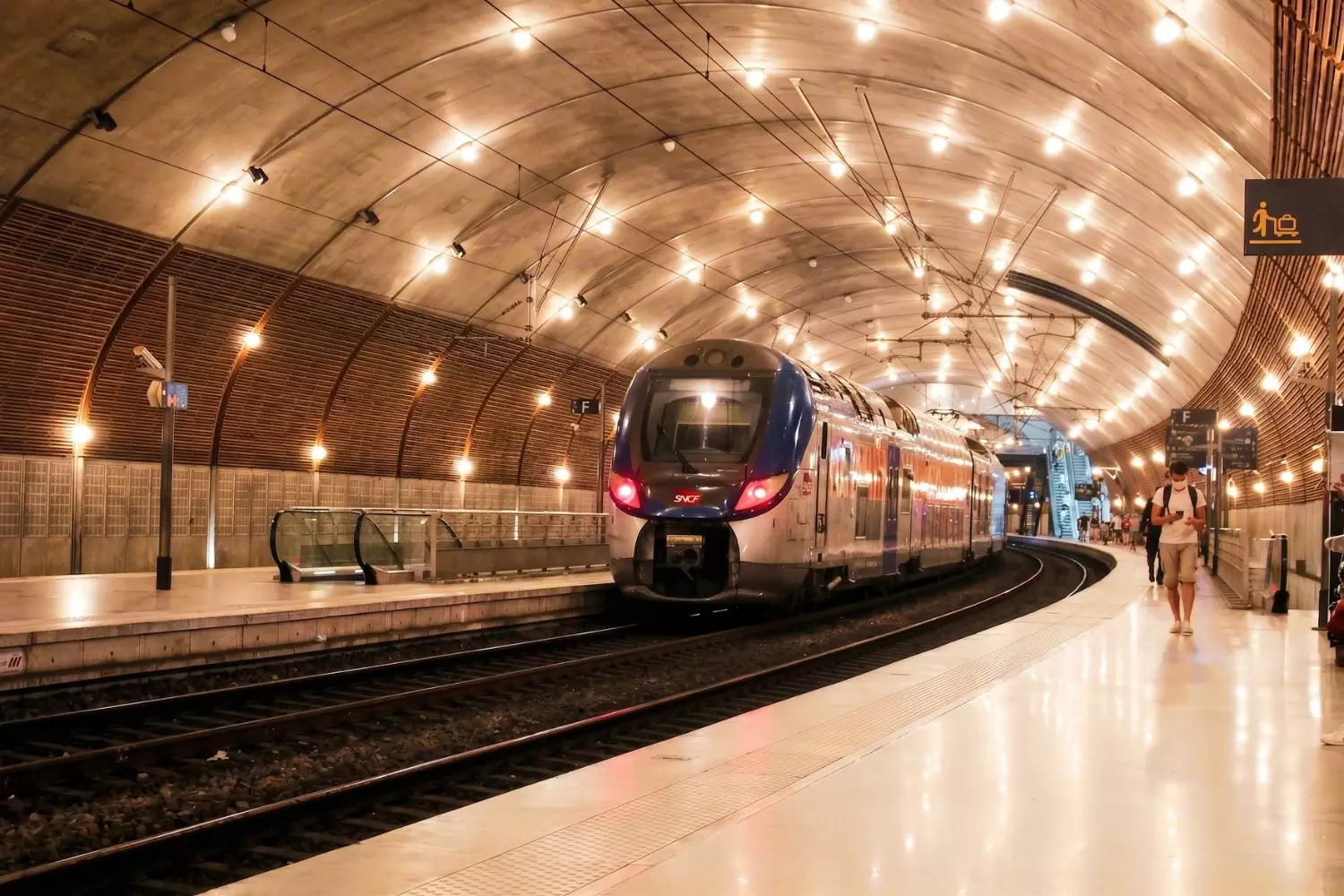
Travel between Nice and Monaco has become a daily challenge for thousands of workers, residents, and visitors. Crowded trains during rush hour, heavy motorway traffic, and unpredictable journey times have made mobility a major issue for the attractiveness of both the Principality and the eastern Alpes-Maritimes region.
Against this backdrop, the Nice–Monaco metro project, more broadly envisioned between Nice Airport and Ventimiglia, has returned to the center of public debate. Long considered too ambitious, this underground metro is now benefiting from renewed political and economic momentum. Although the project is still far from being officially approved, its features and potential impact deserve close attention.
The idea of an underground connection between Nice and Monaco is not new. It was first discussed as early as 2020 before being actively promoted by the Fédération des Entreprises Monégasques (FEDEM), under the leadership of its president, Philippe Ortelli.
In April 2026, Éric Ciotti, who had become Mayor of Nice and President of the Nice Côte d’Azur Metropolitan Area, announced his intention to relaunch the studies dedicated to this infrastructure, acknowledging that it would be both technically complex and costly.
The scenario currently under consideration proposes a fully underground line linking Nice Côte d’Azur Airport to Ventimiglia, with stops including Nice, Monaco, and Menton. The initial projections include:
- Approximately 30 kilometers of track;
- Twelve stations;
- Around 30,000 passengers per day;
- A 23-minute journey between Nice Airport and Monaco;
- An estimated cost of €4 billion.
These figures remain preliminary and will need to be confirmed through detailed technical and financial studies.
FEDEM presented the project once again in June 2026 during the Les Entreprenariales trade fair in Nice. Philippe Ortelli reiterated that transportation difficulties to Monaco weaken the region’s attractiveness, alongside the housing challenges faced by workers. A feasibility study has already been completed by a specialized European engineering firm that is part of a Swiss group.
Monaco’s economy relies heavily on cross-border commuting. Of the nearly 65,000 people working in the Principality, around 80% are estimated to be French nationals. Every morning and evening, a large proportion of these workers travel to Monaco by train, motorway, or coastal roads.
The existing railway line is a vital transport corridor, but its location between the sea and the mountains leaves little room for expansion. Any incident, maintenance work, or service disruption can quickly affect the entire corridor between Nice, Monaco, Menton, and Ventimiglia. Meanwhile, travelling by car remains subject to traffic congestion, fuel costs, tolls, and parking expenses.
A fast and frequent metro service could therefore provide a complementary solution to the existing regional rail network. It would not necessarily replace current infrastructure but could absorb part of the daily commuter traffic while offering an additional transport option for cross-border workers.
This proposal also fits into the broader transformation of mobility already taking place in Monaco, with the development of sustainable transport, electric buses, shared bicycles, and urban planning initiatives aimed at reducing reliance on private cars.
Beyond reducing travel times, the metro between Nice and Monaco could reshape the relationship between the major economic hubs of the French Riviera.
A fast connection to Nice Airport would facilitate travel for residents, tourists, entrepreneurs, and international employees. To the east, extending the line to Menton and Ventimiglia would reinforce the project's cross-border dimension and strengthen economic exchanges between France, Monaco, and Italy.
For Monaco-based businesses, mobility is also a recruitment issue. When daily commuting becomes too long or unreliable, some candidates choose not to accept jobs in the Principality. A dependable transport link could therefore expand the accessible labor pool and enhance Monaco’s appeal for professionals living along the French Riviera.
Improved accessibility could influence residential choices. Today, many people working in Monaco look for housing in neighboring towns or in areas well served by the railway network.
Over the long term, the arrival of new metro stations could increase the attractiveness of certain locations. Municipalities such as Beausoleil, Cap-d’Ail, and Roquebrune-Cap-Martin could benefit from stronger connections to employment centers, the airport, and the main coastal cities.
Proximity to a transport station is generally an important criterion for both tenants and buyers, particularly when commuting plays a major role in choosing where to live.
However, it would be premature to anticipate an automatic rise in property values. The final route, station locations, construction timetable, and financing arrangements have yet to be determined. For real estate investors, the project should therefore be viewed as a development to monitor rather than an immediate guarantee of increased property values.
Building an underground metro line along the French Riviera coastline would be a considerable engineering challenge. The terrain, urban density, and constraints related to station construction will require detailed studies. In Monaco, where available land is extremely limited, integrating new infrastructure would be particularly complex.
Financing remains the other major unknown. With an estimated cost of €4 billion, the project would most likely require cooperation between several public authorities, governments, and institutional partners. Its cross-border nature also implies governance involving at least France, Monaco, and Italy.
Several officials have already expressed doubts regarding its technical and economic feasibility. Supporters of the project, however, argue that infrastructure of this scale must be assessed over several decades. At this stage, the Nice–Monaco metro remains a proposal under study rather than an officially scheduled construction project.
The return of the metro to the public debate already represents a significant shift. Transportation difficulties between Nice and Monaco are no longer seen as simple inconveniences but as a structural issue affecting employment, housing, and economic development.
Even if the project evolves or takes a different form, the announced studies will make it possible to compare various solutions, including an automated metro, upgrades to the existing railway network, new multimodal connections, or a combination of several transport infrastructures.
This discussion aligns with the objectives outlined in the Monaco 2040 vision, where mobility, sustainable urban planning, attractiveness, and quality of life are closely interconnected.
For the real estate market, future announcements will be particularly important. The final route, station locations, and construction schedule could significantly influence the perception of certain neighborhoods and municipalities. Livein.mc will continue to monitor this major project and analyze its potential impact on mobility and real estate in Monaco and across the French Riviera.
No. It remains a proposal currently undergoing studies, with no confirmed construction timetable.
The initial estimates suggest a travel time of approximately 23 minutes.
The current estimate is around €4 billion, although this figure will be refined through future studies.
Improved transport links could increase the attractiveness of certain areas, but the actual impact will depend on the final route and the location of the stations.
Situated on the heights of the French Riviera, Èze is an exceptional commune renowned for its spectacular panoramas, medieval old town, and a peaceful lifestyle paired with Riviera prestige. For both buyers...
Continental, a name with an international resonance. The name can be found in almost every major city in the world. It's often associated with hotels, but in Monaco, because of the Principality's singularity,...
A gem nestled between Nice and the Principality, Villefranche-sur-Mer embodies the essence of the French Riviera: colorful streets, historic façades, and breathtaking sea views. Its bay is ranked among...

This site is protected by reCAPTCHA and the Google Privacy Policy and Terms of Service apply.
