Acquiring property in Monaco is an exceptional wealth-building choice in a highly sought-after market. The Principality offers a transparent legal framework, remarkable legal security, and a tax environment unmatched on an international scale. However, buying in Monaco requires understanding the established practices. We will explain them in this guide.
To summarize this guide, here are the ten steps of a real estate acquisition in the Principality
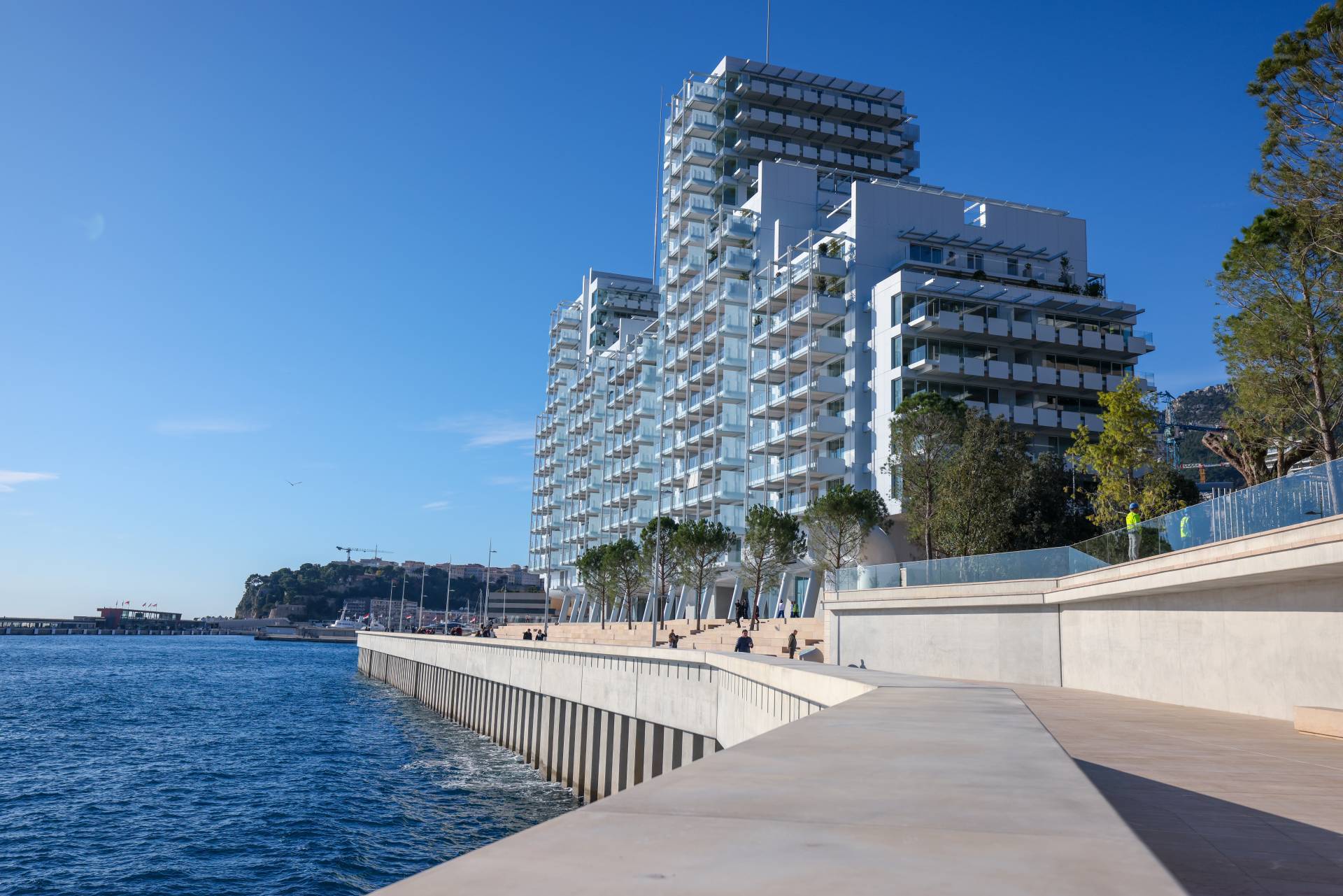
The Monaco real estate market is based on a balance between strong global demand and very limited supply. Enclaved between the Mediterranean Sea and the Alpine foothills, the Principality can only expand its territory by reclaiming land from the sea, as illustrated by the Mareterra project delivered in autumn 2024.
As a result, prices have been continuously increasing for more than a decade. In 2024, the average price per square meter in the resale market reached a record €51,967, up 44% over ten years, according to IMSEE. In 2025, this average stands at €57,569/m², the second-highest level ever recorded.
Behind the overall average, the reality varies significantly by area. The market is divided as follows :
The choice of district in Monaco determines both the current value of the property and its future liquidity and resale potential.
The Monaco market is evolving toward larger residences, reflecting the Principality’s appeal to both families seeking primary residences and investors. In 2025, more than eight out of ten newly sold properties have at least four rooms. Prices reflect this ultra-premium positioning: the average price of a new property exceeds €40.8 million for the first time, with a median of €21.2 million.
Studios do exist in the resale market. 96 were resold in 2025. They remain rare in new developments (less than 7% of sales). Their average price surpassed €2 million in 2026, up 5.5% year-on-year.
Buying a new property in Monaco or one under construction (VEFA: sale in future state of completion) is cheaper in administrative fees: 2.5% of the purchase price compared to 6.25% for resale properties.
In Monaco, the real estate market has an organizational feature that often surprises newcomers: almost all agencies share their property databases. This means that by mandating a single trusted agency, you gain access to the entire available market, whether public or off-market. This gives you a single point of contact with a global market overview, able to organize visits and assist throughout negotiations.
Agency fees are paid by the buyer and are set by the Monaco Real Estate Chamber at 3% excluding tax of the sale price (3.6% including VAT). It is therefore in your interest to choose a reputable agency with a strong network and deep knowledge of local legal specifics.
Monaco offers several ways to acquire property, each with different tax implications. Here are the four options :
This choice must be made before submitting any offer and discussed with an experienced wealth advisor in Monaco.
One of the differences between Monegasque law and French law lies in the irrevocable nature of the purchase offer once it has been countersigned by the seller. Unlike France, where a statutory ten-day withdrawal period protects the buyer after signing the preliminary sales agreement, Monaco does not provide for such a mechanism outside of conditions precedent expressly stipulated in the offer. Once the offer has been accepted and countersigned by both parties, it becomes legally binding on both the buyer and the seller.
If the buyer withdraws after acceptance, they forfeit their 10% security deposit. Conversely, if the seller withdraws, they are required to refund double the amount of the deposit paid.
You must be fully committed before signing and ensure that any conditions precedent (obtaining financing, completion of works, etc.) are included in the offer from the outset.
For a written purchase offer to be valid and enforceable, it must contain a number of specific elements. It must include a detailed description of the property, the proposed purchase price and the validity period of the offer, the full identity of the purchaser together with proof of address, as well as details of the notary fees and agency commission. The offer must also specify the name of the notary chosen by the parties, as identifying the notary at this stage is a Monegasque legal requirement.
The purchaser signs the offer in the presence of the agency, which then submits it to the owner for acceptance. Once approved by the seller, a deposit cheque is sent to the notary (or a bank transfer is made within 48 hours) for an amount equal to 10% of the offered purchase price. This deposit is held by the notary until the transaction is completed.
The Monegasque property market is a sellers’ market, where the imbalance between supply and demand results in narrower negotiation margins than in most other markets. This does not mean that negotiation is impossible, but it must be approached with discernment.
Properties that have remained on the market for an extended period without finding a buyer generally offer greater room for negotiation. Conversely, rare properties or those newly listed on the market may attract several offers simultaneously.
Your real estate agent is your greatest ally in this process. Their knowledge of transactions within the same building or neighbourhood, their access to data from the Real Estate Observatory of the IMSEE, and their relationships with other professionals in the market enable them to formulate a credible offer and effectively present its merits to the seller.
In Monaco, only three notary offices are authorized to handle real estate transactions. Notaries are appointed by sovereign decree and act on behalf of the State.
As of 2026, these three offices are :
This highly centralized system guarantees maximum legal security. The choice of notary is mutually agreed upon by both parties at the time of the offer. Their presence is mandatory at every stage of the transaction.
Upon receipt of the security deposit, the notary initiates a series of verifications. They confirm the identity of the parties, the validity of the title deeds, the property's ownership history, and verify that no undisclosed mortgages or encumbrances affect the property.
The notary also checks whether any pre-emption rights exist. Certain properties in Monaco are subject to regulations granting a third party a preferential right to acquire the property. If this is the case, additional time is required for the waiver or expiration of that right. This may extend the transaction process by several weeks.
This due diligence phase generally takes between two and four weeks for standard transactions and up to one month in more complex cases. It helps protect both the buyer and the seller against any hidden administrative or legal defects.
The completion of the transaction takes place during an appointment organised by the notary, attended by the buyer, the seller, and a representative of the agency. At this stage, the buyer transfers to the notary the balance of the purchase price, the notary fees, and the agency commission (by bank transfer).
The authentic deed, bearing the notary’s seal and signature, carries the same legal authority as a final court judgment. It is immediately enforceable upon signature, providing complete legal certainty for both parties. It is only at this moment that legal ownership is formally transferred, and the buyer receives the title deed as well as the keys to the property.
In cases where no conditions precedent apply, it is possible to proceed directly to the signing of the deed of sale without first entering into an intermediate preliminary agreement.
For buyers who do not wish to fully self-finance, mortgage financing is the most common option. Private banks in Monaco offer tailor-made solutions for high-value transactions.
Key points to know :
Three main financing structures exist in the Monaco market.
Fixed-rate mortgage : your monthly repayments remain unchanged throughout the entire loan term. Ideal if you want complete visibility over your financial commitments.
Variable-rate mortgage : indexed to the Euribor, it may offer more attractive initial conditions. However, it exposes you to market fluctuations. A capped-rate clause (typically limited to ±1% or ±2%) can help reduce this risk.
Hybrid-rate mortgage : fixed for the first 7 to 10 years, then converted to a capped variable rate thereafter. A balanced option for medium-term projects.
Non-resident purchasers in Monaco who do not wish, or are unable, to open a bank account in Monaco have two alternative financing options.
A mortgage loan obtained in France and secured against an existing French property can release liquidity to finance a purchase in Monaco, typically up to 70% of the value of the pledged asset. This approach is particularly suitable for French buyers who already own real estate assets.
Popular among high-net-worth individuals, a Lombard loan is secured by the pledge of an investment portfolio (shares, bonds, investment funds, etc.). This solution allows investors to keep their portfolio invested while accessing funds for the acquisition.
Regardless of the financing solution chosen, the bank generally requires two to three weeks to review the application and make a decision, followed by approximately thirty days to issue a conditional offer. A ten-day consideration period then applies before final acceptance.
In Monaco, acquisition costs vary depending on who you are and how you purchase the property. An individual buyer, a Monegasque company, an offshore structure, or a property dealer will not be subject to the same rates, and the difference can be substantial.
For a purchase made in your own name, you should generally budget approximately 10% in additional costs on top of the purchase price (including notary fees, registration duties, and agency commission). This figure is approximately 6% for a new-build property or a VEFA property. Depending on the value of the transaction, the difference can amount to several tens or even hundreds of thousands of euros.
The real estate transaction process in Monaco is distinguished by its relative speed compared with neighbouring markets (provided that the purchaser is well prepared!). Once the offer has been accepted and the security deposit paid to the notary, the regulatory verification phase begins.
For a transaction without any pre-emption rights, the period between acceptance of the offer and the signing of the authentic deed is generally two to three weeks. Where a pre-emption right must be cleared, this period extends to approximately one month. If the purchaser requires bank financing, additional time must be allowed for the processing of the loan application. In such cases, the financing process generally takes between two and six weeks, depending on the bank and the completeness of the application, bringing the total timeframe to approximately two to three months.
Although a purchase offer in Monaco becomes binding upon acceptance, it is possible to include conditions precedent: these are clauses that protect you if a specific event occurs.
The most common is a condition precedent relating to the obtaining of bank financing. If your loan application is rejected within the agreed timeframe, the offer becomes null and void and your deposit is refunded. Other conditions may relate to the completion of prior works, the removal of an easement, or confirmation of the property's mortgage status.
These clauses must be drafted carefully from the purchase offer stage, ideally under the supervision of the appointed notary. Only realistic and verifiable conditions should be included. A condition that is too vague may weaken the transaction or expose you to liability in the event of a dispute.
A few days before completion, the notary will provide you with a detailed statement of account specifying the exact balance due, after deduction of the security deposit already held. This balance (remaining purchase price + notary fees + registration duties + agency commission) must be credited to the notary's escrow account no later than the day of signing, by bank transfer. Any failure to do so may result in the postponement or cancellation of the transaction.
On the day of signing, after the deed has been read and each page initialled, the keys to the property are handed over to you. You become the legal owner on the exact date specified in the deed. The physical presence of both parties is required, or alternatively their representation through an authentic power of attorney executed before a notary.
A common misconception is that purchasing a property in Monaco automatically grants residency rights. In reality, these are two separate processes.
Any foreign national wishing to reside in the Principality for more than three months per year must obtain a residence permit from the Directorate of Public Security. To obtain one, several conditions must be met simultaneously:
Possessing a property facilitates the process of obtaining Monegasque residency but does not replace the other requirements.
As for entry formalities, nationals of the European Union and the EEA benefit from a simplified procedure. Nationals of third countries must first obtain a Type D establishment visa from the French authorities.
On the financial level, the Monegasque authorities want to ensure that you can meet your needs without relying on social assistance. In practice, this is reflected by:
Three types of residence permits exist depending on your length of residence:
| Card type | Duration | Eligibility condition |
|---|---|---|
| Temporary card | 1 year (renewable twice) | upon arrival |
| Ordinary card | 3 years | after 3 years of continuous residence |
| Privileged card | 10 years | after 10 years of residence |
Note: the accommodation must correspond to the actual needs of the household. A family of four people cannot justify its residence with a studio, whatever its income.
Obtaining the residence permit is only the first step. To retain it, you must actually reside in Monaco for at least six months per year.
The Monegasque authorities are attentive to this point. Checks may relate to objective indicators: electricity consumption with SMEG, Monegasque bank statements, card purchases in the Principality. A purely formal residence (without actual residence) exposes you to the non-renewal of the residence permit.
This is consistent with the tax advantages attached to Monegasque residence. No income tax (for non-French nationals), no wealth tax, no tax on private capital gains. These advantages apply only to residents who have fulfilled their presence obligations.
In Monaco, certain apartments are subject to rules that limit what you can do with them once you become the owner. For example, they may prevent you from occupying them freely or from setting the rent as you wish. These properties are referred to as “law-regulated apartments”. Before making an offer, ask your agent and your notary whether the property is concerned, and what this changes for your project.
Certain buildings in Monaco are subject to a right of pre-emption, exercised by the Monegasque State or by certain third parties designated in the co-ownership regulations. This means that the transaction can only be finalised after the expiry of a legal period during which the beneficiary may decide to acquire the property under the same conditions as your offer. This period, which may reach one month, must be taken into account in your acquisition schedule.
Another point not to be overlooked: if the property is occupied by a tenant, the tenant does not have a right of pre-emption, unless this right has been expressly provided for in the lease agreement. Outside of this contractual agreement, you will have to wait until the expiry of the lease before being able to dispose of the property freely.

This site is protected by reCAPTCHA and the Google Privacy Policy and Terms of Service apply.