Many buyers underestimate the costs of purchasing a property in Monaco. Registration duties, notary fees, agency fees: in a market where the price per square metre is close to €58,000, even the smallest percentage represents tens of thousands of euros. In the Principality, these items are nevertheless regulated and predictable. This guide gives you all the key elements to anticipate them.
In Monaco, all real estate transactions must take place before a Monegasque notary. The notary is the public officer who guarantees the legal security of the operation. He verifies the compliance of the deed with Monegasque law, ensures the absence of charges or mortgages, and authenticates the transfer of property.
The Principality currently has three notarial firms authorised to execute sale deeds. Each party may freely choose its own notary, this differs from the French system where only the buyer’s notary intervenes.
The purchase process in Monaco begins with the signing of a preliminary agreement and the payment of a deposit. Once financing is obtained and the conditions are lifted, the sale is finalised before a notary. It is then that the payment of the balance, agency fees and notary fees is made. In Monaco, however, it is necessary to take into account the State’s right of pre-emption which may delay the final signature by one month.
In Monaco, the purchase offer is accompanied by a 10% deposit of the sale price, handed to the notary who acts as the legal escrow agent. This amount is a standard practice in the Monegasque market, confirmed by the Princely Government of Monaco. This deposit is not an additional cost. It is deducted from the total price at the time of signing the authentic deed. On a property worth €1 million, €100,000 must be available at the time of the purchase offer.
The reservation deposit serves as a mutual protection mechanism. In the event of withdrawal by the buyer without a reason provided for in a suspensive condition, the deposit is retained by the seller as contractual compensation. Conversely, if the seller withdraws, he must pay the buyer an equivalent amount as compensation. This symmetry of obligations ensures a balance between the parties and encourages each party to honour its commitments until the final signing.
Registration duties are a tax levied by the Monegasque State on each real estate transfer. They are calculated as a percentage of the sale price and paid at the signing of the authentic deed, not at the preliminary agreement. It is the notary who collects them on behalf of the Tax Services Department. They constitute the most important tax item in an acquisition.
Unlike agency fees, they are not negotiable: their rate is set by law. The applicable rates are defined by Law No. 580 of July 29, 1953 and its amendments, notably Law No. 1.381 of June 29, 2011, published in the Journal de Monaco. They must not be confused with notary fees, which are a separate remuneration paid to the public officer.
Acquisition costs in Monaco vary depending on the legal status of the buyer and the type of property. The table below summarises the applicable rates.
| Type of acquisition | Notary fees | Registration duties | Total |
|---|---|---|---|
| New property or VEFA (first sale) | 1,5% | 1% | 2,5% |
| Resale – individual or Monegasque SCI | 1,5% | 4,75% | 6,25% |
| Resale – property dealer (professional) | 1,5% | 0% (revente sous 4 ans) | 1,5% |
| Monegasque SCI shares (holding property) | Sur devis | 4,54% sur valeur bien | ≈4,75% |
| Offshore or foreign company structure | 1,5% | 10% | 11,5% |
| Life annuity purchase | 1,5% | 4,75% | 6,25% |
Data sourced from: Laws No. 1.381 of June 29, 2011, No. 580 of July 29, 1953, No. 1.548 of July 6, 2023. These can be confirmed by a Monegasque notary.
The purchase of a resale property by an individual or a Monegasque SCI represents the majority of transactions. The costs include:
Total: 6.25% of the price, excluding agency fees. This rate applies only to resales. New properties or VEFA are subject to a more advantageous regime.
A new-build property or VEFA benefits from a reduced regime. The costs include:
Total: 2.5% of the price. This reduced rate is explained by the 20% VAT already included in the developer price. In 2025, the average price of a new property in Monaco reached €40.8 million. At these levels, moving from 6.25% to 2% represents a saving of several hundred thousand euros.
Acquisitions via an offshore or foreign company are subject to deliberately dissuasive taxation. The costs include:
Total: 11.5% of the price. This surcharge aims to limit opaque structures and strengthen the traceability of the beneficial owners. Agencies, notaries and banks are all subject to enhanced due diligence obligations.
Agency fees are regulated by the Monegasque Real Estate Chamber. For the buyer, they amount to 3% excluding tax, i.e. 3.6% including tax after 20% VAT. They cover property search, negotiation, coordination with the notary and support until signing. Some agencies also offer rental or asset management services after the transaction.
Some buyers engage a lawyer specialised in Monegasque law to audit the property before signing: hidden charges, co-ownership regulations, urban planning authorisations. This is not a legal requirement but a precaution. For acquisitions via a Monegasque civil company, the joint involvement of a notary and a lawyer is almost systematic.
Based on a €1,000,000 property, here is a comparison between resale and VEFA purchase for an individual buyer.
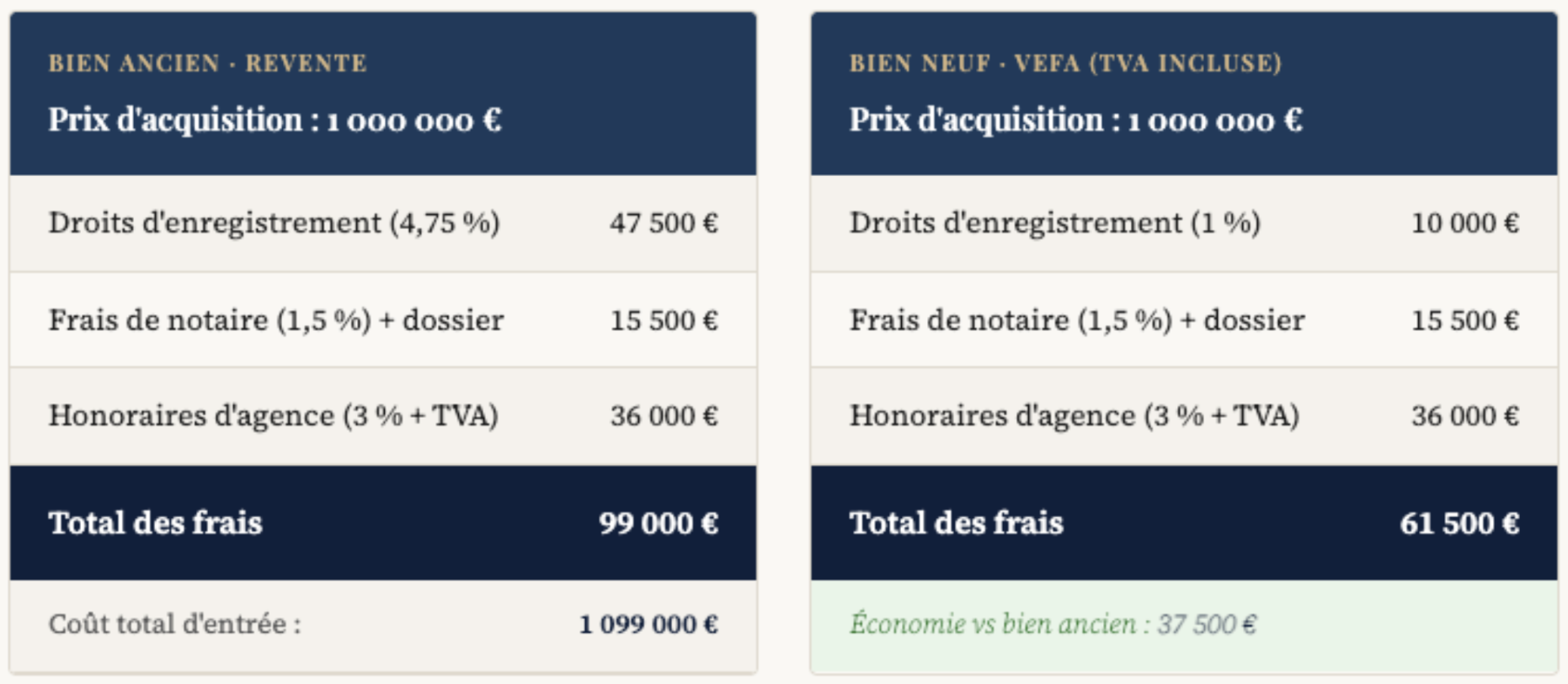
Indicative data for example purposes.
You want to estimate these costs for a specific property? View apartments for sale in Monaco
According to the Princely Government of Monaco, there is no property tax, no housing tax, and no wealth tax in the Principality. Once acquisition costs are paid, only co-ownership charges apply each year. For a complete overview of tax advantages for Monaco residents, consult our dedicated guide.
The same official site confirms the absence of capital gains tax on real estate for resident individuals. In a market where prices have increased by 42% over ten years (from €40,599 in 2016 to €57,569 in 2025 according to the 2025 Real Estate Observatory of the IMSEE), this advantage is significant.
Note: French citizens are governed by the Franco-Monegasque bilateral convention of 1963, which may maintain taxation in France regardless of their residence.
For a resale property, the costs amount to 6.25% of the price: 4.75% registration duties (Law No. 580 of 29 July 1953, amended by Law No. 1.381 of 2011 and then by the law resulting from bill No. 1048) and 1.5% notary fees. Administrative fees of approximately €500 are added depending on the notarial office. Agency fees of 3.6% including VAT are separate and regulated by the Monegasque Real Estate Chamber. The 10% deposit paid at the preliminary agreement is not a cost: it is deducted from the final price.
A new property or VEFA is subject to 2.5% fees: 1% registration duties and 1.5% notary fees, in accordance with Law No. 1.381 of 29 June 2011. An existing property is subject to 6.25%. On a €1,000,000 property, the difference is €37,500.
Agency fees are set at 3% excluding tax of the sale price, i.e. 3.6% including tax after 20% VAT, in accordance with the scale of the Monegasque Real Estate Chamber. They cover property search, negotiation, coordination with the notary and support until signing. They are payable by the buyer, unless otherwise stated in the mandate.
The fees amount to 11.5% of the price: 10% registration duties and 1.5% notary fees. The 10% rate for non-transparent structures was set by Law No. 1.548 of 6 July 2023, adopted as part of the recommendations of the MONEYVAL report on anti-money laundering.
No. The Princely Government of Monaco confirms on its official website (monservicepublic.gouv.mc) the absence of property tax, the absence of housing tax and the absence of wealth tax. There is also no capital gains tax for resident individuals. The only recurring cost is co-ownership charges. Exception: French citizens remain subject to the Franco-Monegasque bilateral convention of 1963.

This site is protected by reCAPTCHA and the Google Privacy Policy and Terms of Service apply.
