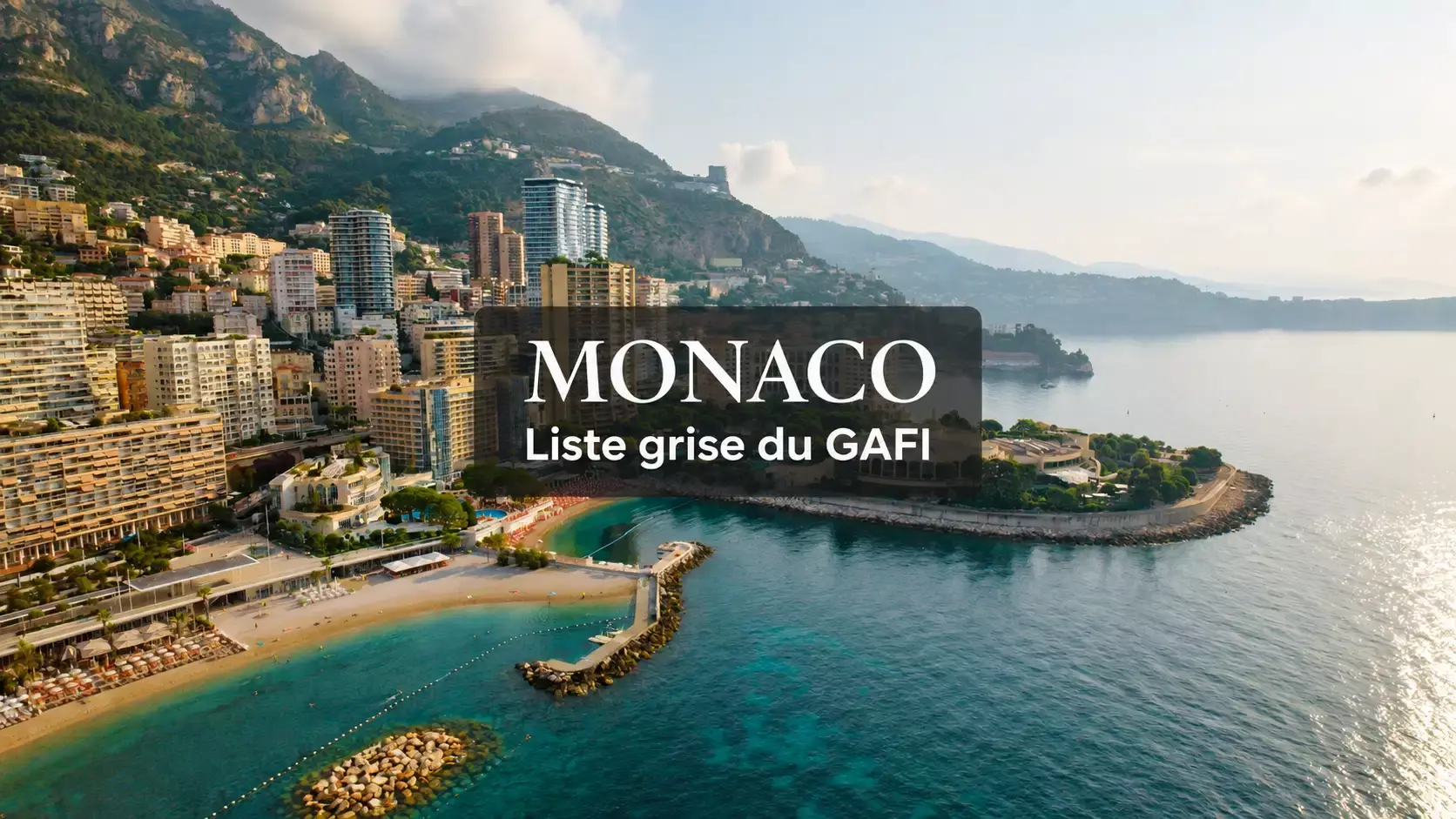
Since June 2024, Monaco has been on the “grey list” of the Financial Action Task Force, better known by the acronym FATF. This listing placed the Principality under increased monitoring regarding efforts to combat money laundering and terrorist financing.
Two years later, however, the situation has changed considerably. In June 2026, the FATF made a preliminary determination that Monaco had substantially completed its required action plan, paving the way for an on-site visit before a possible removal from the list. In September 2026, the Monegasque authorities stated that they were still preparing for this next stage of the process.
The Financial Action Task Force is an intergovernmental body responsible for setting international standards to combat money laundering, terrorist financing and proliferation financing.
Its “grey list” officially includes jurisdictions subject to increased monitoring.
Being placed on this list therefore does not mean that a country is considered to be deliberately facilitating money laundering. It indicates that the FATF has identified strategic deficiencies in its framework and that the jurisdiction concerned has committed to addressing them through a defined action plan.
Monaco was placed on the list on 28 June 2024. This followed, in particular, the MONEYVAL evaluation report adopted in December 2022, which assessed the effectiveness of Monaco’s framework for combating money laundering and terrorist financing.
When Monaco was listed, the FATF already acknowledged several improvements made by the Principality, including the creation of a new financial intelligence and supervisory body and the strengthening of measures relating to terrorist financing.
Nevertheless, six main areas required improvement: understanding the risks of money laundering and tax fraud committed abroad, international cooperation to identify and seize criminal assets, the application of anti-money laundering sanctions, strengthening the financial intelligence unit, the effectiveness of the judicial response and increasing seizures of assets derived from criminal activities.
19 June 2026 marked an important development.
Following its plenary meeting, the FATF made a preliminary determination that Monaco had substantially completed its action plan.
The international organisation specifically acknowledged progress in risk analysis, cooperation with foreign authorities, the application of sanctions, the resources of the financial intelligence unit, judicial effectiveness and seizures of assets potentially derived from criminal activities.
However, Monaco was not immediately removed from the grey list.
The FATF determined that an on-site visit was now necessary to verify that the reforms were not merely set out in legislation, but were effectively implemented and sufficiently sustainable.
In September 2026, the Monegasque Committee responsible for monitoring the national anti-money laundering strategy stated that preparations for this visit were still underway. At this stage, the Principality therefore officially remains under increased monitoring.
This issue is particularly important for real estate, given the sums involved in Monegasque transactions and the high proportion of international buyers.
Being on the grey list does not prevent a foreign national from buying an apartment in Monaco. The Principality imposes no general restrictions on property purchases based on nationality or residency status. The conditions applicable to international buyers are detailed in our guide tobuying in Monaco as a foreign national or non-resident.
However, customer due diligence obligations and requirements to establish the source of funds take on greater importance.
As part of the property buying process in Monaco, banks, relevant professionals and notaries must ensure that the funds used can be traced. For major purchases, particularly those involving several jurisdictions or complex wealth-holding structures, preparing the financial documentation in advance therefore becomes essential.
It is still too early to isolate any potential impact of the FATF listing on property prices or investment volumes.
In any case, the latest available data does not indicate a halt in property activity. The market remains supported by land scarcity, an international clientele and transactions involving particularly high sums.
For investors, the main immediate consequence relates more to compliance and financial documentation than to access to the market itself.
Nevertheless, the listing represents an important issue for the reputation of Monaco’s financial centre, which explains the authorities’ efforts since 2022 to strengthen the regulatory framework and demonstrate its effectiveness.
Yes. As of today, and since 28 June 2024, Monaco remains among the jurisdictions subject to increased FATF monitoring. In June 2026, however, the organisation determined that the Principality had substantially completed its action plan and approved an on-site visit ahead of a possible removal.
The FATF had identified several shortcomings, particularly regarding the effectiveness of sanctions, international cooperation, the resources allocated to financial intelligence and the justice system, and seizures of criminal assets. Monaco committed to addressing these issues through an action plan.
The process is now well advanced, but removal cannot be considered guaranteed before a formal FATF decision. After determining in June 2026 that Monaco had substantially completed its action plan, the organisation must conduct an on-site visit to verify the effectiveness and sustainability of the reforms.
Yes. Being on the grey list does not prohibit property purchases in Monaco, and foreign investors can still acquire property. However, checks on the buyer’s identity and the source of funds may be particularly thorough. To prepare for a purchase, consult our guide to the property buying process in Monaco

Located between Cap de Nice and the iconic Cap-Ferrat, Beaulieu-sur-Mer embodies the understated elegance of the French Riviera. Its palm-lined waterfront, Belle-Époque façades, and sheltered harbor give...
With just over 2 km² of land, Monaco is one of the most densely populated countries in the world. In this context of extreme land scarcity, every square meter counts. To house its growing population, attract...

The conception of this new eco-district, whose delivery is planned in 2025 is the first ever in Monaco. Let’s go back on a both technological and environmental challenge.

This site is protected by reCAPTCHA and the Google Privacy Policy and Terms of Service apply.
